State Space Models

All state space models are written and estimated in the R programming language. The models are available here with instructions and R procedures for manipulating the models here here.
Showing posts with label world-system. Show all posts

Monday, November 24, 2025

Liberalsim vs. Neoliberalism


I have been trying to reconcile Liberalism with Neoliberalism and put the two within David Easton's Political System. My reconciliation is:

Neoliberalism was very specific about specifying required values for Political Outputs, Liberalism less so. However, the Liberalism positions an be "filled in" by contrast to available Neoliberal positions.

First,  I'll summarize Easton's model and then go on to expand on his Political Outputs. Finally, I'll ask what Political Inuts and Feedback have to do with Liberal and Neoliberal models.


Notes

ChatGPT

Feature

Liberalism

Neoliberalism

Time period

18th-19th century origins

Late 20th century

Primary goal

Broad individual freedom

Market efficiency & competition

View of the state

Limited but essential for rights

Minimal, facilitator of markets

Markets

Useful but not absolute

Central organizing principle

Social policy

Some support for welfare

Shrink welfare; use market mechanisms

Freedom

Civil and political freedom

Freedom as market choice

Attitude toward inequality

Liberties more important, but some thinkers favor moderation

Often accepts inequality as necessary


Sunday, March 23, 2025

Wolf Hall II and the Modern World System (1450-1640): Consulting Astrologer John Dee


I hope you are watching the final episodes of Wolf Hall Season 2 on PBS starting last Sunday, March 23, 2025 (the link is here and you might find parallels to the current political situation in the United States). In a prior post (here) I discussed Season 1. In this post, I will start laying some groundwork for Season 2. In future posts, I'll comment on the remaining episodes (you can stream Season2, Episode 3, Defiance or watch it over the air tonight).

Thomas Cromwell, the central character in the Wolf Hall TV series, lived from 1485-1540 during a period called the Long Sixteenth Century (L16, more information will be posted here). Cromwell was Henry VIII's chief minister and played a prominent role of the beginning of the English Reformation.

To help me understand the The Tudor Period (1485-1603), I've constructed a number of state space models for England, France, Spain, Italy, Germany, Portugal, the World System and other countries in the World-System using available historical statistics (see the country models here that will be attached to future posts)The most noteworthy aspect of my WL16 state space World System model (here) are the two Growth Error Correcting Controllers (ECCs), one is an environmental controller (Q-T) and another is a Malthusian Population and Production controller (Q-N)--see the Measurement Matrix in the Notes below. I can also compare the WL16 model to a conventional economic growth model driven by technological change.*


In the  Wolf Hall TV series, we are seeing the Tudor elites (Thomas Cromwell and Henry VIII) in all their splendor. All the heavy, elegant clothing had a purpose: the castles were cold and drafty and this was the Little Ice Age in Europe (graphic above from Waldinger, 2022). We find out little about the lower classes in the TV series, but we can be sure they suffered.

Another important aspect of the Long Sixteenth Century was that it was the start of Capitalist Agriculture and the formation of the World-System (discussed here and here). The evolution of the World-System is my primary interest in the Wolf Hall TV series because it helps bring the history to life.

Historical re-interpretation is another way to bring history to life and Hillary Mantel does this in Wolf Hall (see the Real Story Behind Wolff Hall and the Fall of Cromwell from the Smithsonian Magazine).


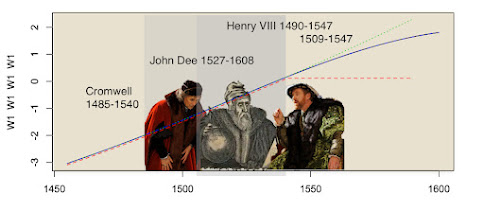
I'm going to extend Hillary Mantel by including John Dee (a character not in "Wolf Hall"). ChatGPT (here) reports that Henry VIII "...did rely on astrologers like John Dee (who later advised Elizabeth I) and may have had private interactions with individuals claiming to predict the future." In the graphic above, I assume that sometime before Cromwell's execution, John Dee made two predictions, one (optimistic forecast) for Henry VIII and one (less optimistic) for Thomas Cromwell. The optimistic forecast was "unlimited growth forever" (the dotted green line in the graphic above) and the less optimistic forecast (the black-blue line) for a Limit to Growth (the dashed red line was the Random Walk--history is just one damed thing after another).

I'm going to imagine that Henry VIII's response to the optimistic forecast was "Surely, Doctor Dee, I should care not for such World Systems when my appetites are solely for England."** Cromwell was not so dismissive in his response but encouraged Master Dee to focus on the best Geopolitical Alliance Henry might find through marriage. 


Dr. Dee went back to his extensive library in Mortlake, Surrey in England, dusted off his protractor and constructed geometric forecasts for Henry VIII and later Elizabeth I (Henry's daughter). In these forecasts, Dee was careful not to be seen as an unwitting tool of evil spirits. In future posts I will report on modern day versions of Dr. Dee's imaginary forecasts and concentrate on finding the best Geopolitical Alliances for Tudor England.


Notes

* The Environmental and Malthusian controllers are not the only ECCs that can exist is a socio-technical system, but they were the most important in the Long Sixteenth Century. Dynamic Component Models (DCMs) divide system variables into growth and cyclical component state variables. The growth component is equivalent to an economic growth model. The feedback components describe ECCs. Neoclassical Economic Growth theory has no concept of feedback and Climate Change models have struggled to identify feedback loops in Human Systems,

** Unfortunately, for Henry VIII's appetites and intuitions, the World System (specifically the WL16 model) was an important driver of England's development during the Long Sixteenth Century.

Data were taken from the Maddison Database and the Measurement Matrix (below was constructed from the available data using Principal Components Analysis, PCA). Q =  Aggregate Production, N= Population and T = Global Temperature. During the Long Sixteenth Century there was no concept of Aggregate Production, Aggregate Population, Global Temperature or the World System.


More detail about the model will be made available in future posts. You can run both and unstable and stabilized version of the WL16 model here. For more technical information, see the Boiler Plate.


Links

Wednesday, March 19, 2025

Boiler Plate


State Space Model Estimation

The Measurement Matrix for the state space models was constructed using Principal Components Analysis with standardized data from the World Development Indicators. The statistical analysis was conducted in an extension of the dse package. The package is currently supported by an online portal (here) and can be downloaded, with the R-programming language, for any personal computer hereCode for the state space Dynamic Component models (DCMs) is available on my Google drive (here) and referenced in each post.


Atlanta Fed Economy Now

My approach to forecasting is similar to the EconomyNow model used by the Atlanta Federal Reserve. Since the new Republican Administration is signaling that they would like to eliminate the Federal Reserve, the app might well not be available in the future.


While the app is still available, there have been some interesting developments. In earlier forecasts, the Atlanta Fed was showing GDP growth predictions outside the Blue Chip Consensus. Right now, after unorthodox economic policies from the Trump II Administration, the EconomyNow model is predicting a drastic drop in GDP (the Financial Forecast Center is only predicting a slight drop here).

Climate Change

Another comparison for what I have presented above are the IPCC Emission Scenarios. These scenarios are for the World System. Needless to say, (1) the new Right-Wing Republican administration plans on withdrawing the US from all attempts to study or ameliorate Climate Change and (2) the IPCC does not produce any RW modes for the World System (but seem my forecasts here).


World System

The longest running set of data we have for the World-System is the Maddison Project based on the work of Angus Maddison (more information is available here). Data on production (Q) and population (N) for most countries and regions runs from years 0-2000. More data becomes available as we near the year 2000. 


Available data were entered in a spreadsheet (see Population above, double click to enlarge). Missing data were interpolated with nonlinear spline smoothing using the R programming Language.


In cases where initial values were not available (see GDP above), the E-M Algorithm was used to estimate initial conditions.

From the graph of GDP above (W_Q) for the World System, it can be seen that economic growth from the year 0-1500 was basically flat. The period of British Capitalism (after 1500) had a small plateau of growth. Takeoff does not happen until the Nineteenth Century.


From a system's perspective, the only model that can be tested for the entire period is Kenneth Boulding's Malthusian Systems Model [Q,N] = f[Q,N].


When developed as a State Space model (measurement matrix above) there are two components: W1=Growth and W2=(Q-N), the Malthusian Controller. When more data is available, the Malthusian Controller can be generalized to other SocioEconomic theories.

What the Malthusian Controller shows (plotted as Q-N above) is that a long-developing Malthusian Crisis (Q<N) started in the Late Middle Ages and accelerated through the period of British Capitalism (Dark Satanic Mills) and was reversed spectacularly during the Nineteenth Century.  Takeoff in response to a deepening Malthusian Crisis would not be an unreasonable way to view Modern Economic Growth.

Error Correcting Controllers (ECC)


In another post (here), I presented Leibenstein's Malthusian Error Correcting Controller (ECC). It can be generalized to the dominant ECCs in most theoretical economic models (above). These controllers can be further generalized. For example, (X-U) and (L-U) can be generalized to (N-U), a more general Urbanization Controller which describes market expansion for economic growth. In countries and periods with limited data, (N-U) might subsume all these processes. ECCs describe important feedback processes in SocioTechnical System that are typically not recognized as such in academic literature.

Kaya Identity


The basic theoretical model underlying all the World-System models I crate is the Kaya Identity. There are a number of advantages to starting theoretical development with the Kaya Identity: (1) An "identity" is true by definition Adding other variables to the model ensure that theory construction is on a solid footing. (2) The Kaya Identity is also used as the foundation for the IPCC Emissions Scenarios allowing a linkage between World-Systems Theory and the work of the IPCC.


World Development Indicators (WDI)


After WWII, extensive data sets on all countries in the World-System became available from the World Bank (here). The indicators above where chose to construct the state space for each WDI-based model. Addition indicators can be added for specific forecasts and analyses.

Thursday, December 13, 2012

The Modern World-System as a Unit of Analysis


There are a number of variants of world-systems analysis, however Immanuel Wallerstein has arguably developed the best known version. In the video above, Wallerstein talks about why he gravitated toward the world-system as a unit of analysis. He also talks about some of the epistemological problems he encountered when he pursued world-system analysis. The video is poor, but it is the only one I can find which discussed the unit of analysis and provides a useful starting point for this blog.

To him, the state as a unit of analysis didn't make sense, it's not where social action occurred. He saw the states organized within a hierarchical system. The Modern world system evolved in the 15th century and was a significant break, a capitalist world economy.

The epistemological problems hinted at involved the artificial academic disciplines between history, sociology, economics and history. From the standpoint of systems theory, the world system could only be studied from the system perspective, not from the perspectives of narrow academic disciplines.

The epistemological problems were clear to me when I was working on my dissertation in the late 1970's and early 1980's. The University of Wisconsin formally allowed interdisciplinary degrees but the academic disciplines I was interested in bringing together (sociology, history and economics) did not look very favorably on the project. Interestingly, the problems really had to do with the systems models I was using. Economists were not entirely comfortable they way concepts were being operationalized and the strong emphasis on empirical-statistical rather than theoretical model building (Kalman's data -> model approach that I'll discuss later), the sociologists were not yet comfortable with macro analysis and the historians were having trouble with quantitative history.

Wallerstein took, instead, a qualitative approach and was in the end more successful. I still think a quantitative approach to world-systems analysis using systems models is possible, especially since Wallerstein has paved the way with excellent qualitative analysis.

One other important epistemological point is that Wallerstein rejects the idea that he is developing world-system "theory". Rather, he looks at his project as world-systems "analysis". His perspective highlights the problem of theory construction in this area and is a topic I am pursuing in the Causal Macrosystems blog.