State Space Models

All state space models are written and estimated in the R programming language. The models are available here with instructions and R procedures for manipulating the models here here.

Saturday, March 15, 2025

World-System (1950-2010) Trump Takes US on a Random Walk


In a prior post (here), I presented alternative futures for the US Economy. In terms of growth (the USL20 US1 state variable), the best models are the Business-As-Usual (BAU) model or the basic US state space model itself, both without input from the World System or other countries. From a statistician's perspective, this is the Make America Great Again (MAGA) model. Alternatively, the Random Walk (RW) model (history is just one damned thing after another) actually seems to be the best description of the Trump II administration's current (early) performance in office. Finally, from the Akaike Information Criterion (AIC, see the Notes below), the best description of US Growth from (1950-2010) is the RW model.

Does all this make your head hurt? First, no one can know the future. This is why the IPCC presents Alternative Emission Scenarios (here) rather than forecasts for CO2 emissions. The unpredictability of the future is why the Trump II administration (to be charitable) is behaving randomly (here) even though their preferred future is the BAU model with the US dominating the World-System.

The RW is a well-known but little acknowledge business strategy and Trump is trying to run the US government as if it was a business. The business theory is that if you are too predictable in your behavior, your competitors can easily predict your behavior and set up against you. The Left Wing cannot predict what Trump will do next so it is impossible to develop a strategy against him. The approach is similar to the Gish Gallop debating style which is also used by Trump and is difficult to rebut.

How reasonable is the RW model as a description of US growth? In the graphic above, I ran eight simulations of the US1 RW model, starting in 1950. Two of the models produced an upward growth trend, one of the models produced collapse. The other models produced weak performance with a slight negative trend. So, there is about an 88% chance that random management of the US Economy will not produce a crisis and might even produce an upward trend. Those are pretty good odds for a businessmen willing to take large risks and who has no idea how to run a government.

As a comparison, I've done a similar analysis for Mexico (here) where the RW is also the best short-term model and for Canada (here and here) where the BAU model is best. Argentina also is a favorite of the Trump II Administration for it's slash-and-burn policy approach (here); the RW model is also a good competitor (AIC = 76.58) for Argentina (you can run the ARL20 BAU model here) or read the verbal discussion (here).


Notes

 Akaike Information Criterion (AIC) for alternative models shows that the RW model is a strong competitor for US Growth, at least in the short-term.


You can run the USL20 BAU model here. It is also a strong competitor and produces uncontrolled exponential growth, a future growth path favored by many commentators.
 

State Space Model Estimation

The Measurement Matrix for the state space models was constructed using Principal Components Analysis with standardized data from the World Development Indicators. The statistical analysis was conducted in an extension of the dse package. The package is currently supported by an online portal (here) and can be downloaded, with the R-programming language, for any personal computer here. Code for the state space models is available on my Google drive (here) and referenced in each post.


Atlanta Fed Economy Now

My approach to forecasting is similar to the EconomyNow model used by the Atlanta Federal Reserve. Since the new Republican Administration is signaling that they would like to eliminate the Federal Reserve, the app might well not be available in the future.


While the app is still available, there have been some interesting developments. In earlier forecasts, the Atlanta Fed was showing GDP growth predictions outside the Blue Chip Consensus. Right now, after unorthodox economic policies from the Trump II Administration, the EconomyNow model is predicting a drastic drop in GDP (the Financial Forecast Center is only predicting a slight drop here).

Climate Change

Another comparison for what I have presented above are the IPCC Emission Scenarios. These scenarios are for the World System. Needless to say, (1) the new Right-Wing Republican administration plans on withdrawing the US from all attempts to study or ameliorate Climate Change and (2) the IPCC does not produce any RW modes for the World System (but seem my forecasts here).


Tuesday, February 18, 2025

World-System (1960-2010) Mexico Takes a Random Walk


In an earlier post (here) I used the MXL20 model to forecast eight futures for Mexico in the 21st Century. The best model was the Business-As-Usual (BAU) Model, however, in the short-run (year-to-year) the Random Walk (RW) actually had the best Akaike Information Criterion (AIC).


The shocks to the state variable MX1 (the Growth Shocks) are presented above. Mostly, the shocks are positive, except for around the turn of the Century (after 2000)*. In the short-run, year-to-year, the Mexican Economy has been able to continuously adjust to positive growth shocks. 


Notes

* The Growth Shocks are the residuals from the MX1_RW model. You should notice that the residuals are not normally distributed as are the residuals in the simulated MX1_RW presented at the beginning of the post. This is why I compute Bootstrap rather than normal distribution statistics.

AIC Statistics


Wednesday, February 5, 2025

World System: Generalizing the Malthusian Controller


In an earlier post (here), I presented Leibenstein's Malthusian Error Correcting Controller (ECC). It can be generalized to the dominant ECCs in most theoretical economic models (above). 

In future posts, where appropriate, I will explain each controller in more detail. The point to make here is that socio-economic systems are free to emphasize whatever controller seems appropriate during a particular historical period. It is an empirical matter to determine which controllers, if any,  are operating in a particular period. It is not something that can be deduced from theoretical speculation although historical analysis can reveal what was of most concern to elites. But, the historical analysis would just suggest a hypothesis.

Thursday, January 30, 2025

What is Neoliberalism?


Quinn Slobodian (2020) has written a recent book Globalists: The End of Empire and the birth of Neoliberalism. I'm in the process of reading it and the book has changed my perspective on Neoliberalism. In 2018, I had been working on developing a "Neoliberalism Index" but I just couldn't capture the concept with a reasonable number of indicators. So, I decided it was really a hierarchical-concept that was best expressed by a number of indexes (see the hierarchy diagram above). But my concept of Neoliberalism was based purely in the American (Reagan) and British (Thatcher) popular political version. Slobodian opened my eyes to the wider intellectual history that dates back to WWI, the Great Depression and WWII. Let me report how I see Neoliberalsim now and how I think it might be destroyed by the two Trump Administrations which have just come to power again in the US.

First, let's recall how Germany destroyed the Liberal International Order by it's pursuit of World Domination during WWI. The World System and how it was to be reconstructed after WWI was a primary concern of the European Neoliberals. Tracing these concerns helps us understand what WWI was actually about and the role that the World System played in it and continues to play in Geopolitical Alignment.

I have constructed indexes for each of the Neoliberal components: Austerity, Globalization, Financialization, Debt, Hardship, IMF_Pressure and the Ecological Footprint. You can see some of these indexes at work in Shefner et. al. (2015). In future posts I will bring these indexes up to date for other countries in the World-System. My main questions are whether the Neoliberal World Order will be over after the Trump Administrations and what that might mean for the future.

In the meantime, I would recommend reading Globalists: The End of Empire and the birth of Neoliberalism.

Friday, January 17, 2025

World-System (1872-1908) Germany in the World System


World-System (1872-1908) Expanded Outputs of the Classical Model for Germany


In a prior post (here) I tested Higgins (1968) Classical Model on Germany in the late Nineteenth Century. The Higgins model had a number of shortcomings, particularly in the output variables. A market wasn't included and designating Capital as the only Capitalist output could equally be applied to a State Capitalist model and a market based Capitalist system. In this post, I will expand Higgins for Germany and see where it takes us.

Higgins model did allow us to define the essential variables and construct a system state for the Classical model. We can now break out any variables we want and consider them as outputs. The two I will deal with in this post are the Marxist model and the Market model (see the graphic above).

Even though Capital was the primary output for Marx, it is also clear that Ownership was also very important and had to be removed from private hands for the Communists State to emerge. So, let's add a measure of ownership, the GINI Coefficient, to the model. The coefficient is a percentage in the range [0,1] where zero indicates perfect equality (everyone owns an equal share of output) to one (100%) which indicates perfect inequality (Capitalists own al the Capital stock). A similar measure would be the Share of Wealth, another percentage with similar meaning. For Marx, a Capitalist system required not only investment in Capital stock but also a high degree of wealth concentration.

To capture Adam Smith's insights, we would need to add a free market as another output of the system.


Saturday, January 11, 2025

World-System (1872-1908) A Classical Model of German Development


In a prior post (here), I discussed whether we should pay attention to the Classical Economists who wrote in the Nineteenth Century. They had brilliant insights but they lacked the statistical tools to test their ideas. Now that we have the tools and the historical data, there is no reason not to test and extend their ideas. One of the problems is figuring out what the Classics actually meant because their writing was verbose, obscure and difficult for modern readers to wade through.


Benjamin Higgins (1968) (here) has come to our rescue with a book (now out of print but still available used here) that develops a generalized mathematical model of economic development based on the classics (see Chapter 3). He presents eight structural equations (p. 63) and a time plot of the relationship between N (Population) and Q (GDP), above. His Figure 2-3 (above) looks very similar to the time series plot for the German 19th Century model (DEL19) at the beginning of this post which was based on an estimated dynamic state space model. The DEL19 model used the same variables identified by Higgins but did not arrive at the time plot using Higgins classical structural equations. Understanding how the DEL19 model was constructed will help me explain how to approach the Classics with modern tools.

Higgins identifies the following variables as central to the general Classical model: Production (Q), Labor (L), Capital (K), Wages (W), Profits (R), Investment (I)  and Technology (T). Variables can be further grouped (using Systems Theory) as system output state O=(L,Q,T), Endogenous (W,R,I), Exogenous (N) and Output (K) yielding the directed graph above (Higgins actual structural equations are presented below in the Notes--the endogenous variables can be reduced out of the equation system).

To Neoclassical Economists, the directed graph will look strange. Technology is usually taken as exogenous and the Capital stock would be included in the system state. But the Classics believed that Technology had to be embedded within investments and the Capital stock. Also, I think some Outputs are missing from Higgin's model (what happened to Adam Smith's Free Market? What happened to Democracy?) but I'll pick up the issue in a future post on the way to dealing with Liberalism and Neoliberalism.

The Classics also struggled with definitional issues. Did Capital include land, machines, buildings, knowledge, etc.? Were wages driven to subsistence in order to increase profits (R = Q - wL) where w is the subsistence wage. How to define Technology (T)? So many questions, so much speculation, so little testing.

Systems Theory avoids these arguments by defining the System State, S = S(Q,L,K,W,R,I,T), as being a function of all the essential variables in a system. The problem then is to estimate a state variable index and other independent indexes that describe Error Correcting Controllers (ECCs) for the system, that is, describe growth and control as two separate issues that have to be estimated separately for the system--allowing that the system might not be under adequate control.

The Measurement Matrix for the DEL19 state space model is presented above (for the moment, I am assuming that T is exogenous, but I'll pick up the issue in a future post). The first state variable, Classic1, describes overall growth (it's time plot is displayed at the beginning of this post). The second state variable, Classic2 = (0.86 N - 0.48 I), involves monitoring population growth relative to investment. The third state variable, Classic3 = (0.73 I - 0.47 L), involves monitoring investment relative to employment. The first three state variables explain over 99% of the variation in the indicators. The remaining three indicators deal mostly with wage controllers and explain little variance.

There are a number of interesting points about the estimated Measurement Matrix (estimated with Principal Components Analysis), The classics were very interested in Wages and Investment. But, they were also interested in the Capital Stock, K, and it played little role other than as an indicator of system growth in Germany (even though the Nineteenth and Twentieth Centuries are labeled as Capitalist--see below for more discussion in the Notes). 


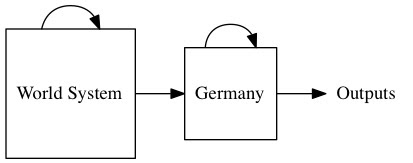
In terms of system behavior, the steady state depicted in the DEL19 Time plot was not the result of the DEL19 BAU model but required input from the World System (see the directed graph above). Understanding that every economy is embedded within the World-System had to wait for the development of World-Systems Theory at the end of the Twentieth Century and the development of Hierarchical Control Systems in the 21st Century.

One other point about the time plot at the beginning of this post: WWI, the Great Depression and WWII are not explained by the forecast. In spite of the disruption of the Inter-War Years, we now know that the German Economy is starting to reach a steady state in the 21st Century (even though some Economists are labelling the approaching steady state as a crisis).

You can run both versions (unstable and stable) of the DEL19 Classic model here.

Summary

What can we learn from a Classical Model of German Development?
  • It is not easy to just speculate and try to understand Complex Systems. The systems are Black Boxes that only reveal their behavior by observing inputs and outputs.
  • Higgins Classical model (see below) is static whereas writers such as William Baumol (1960) thought the primary attribute of Classical Models were their "Magnificent Dynamics" (download pdf here).
  • The Classics were willing to go ahead and speculate without clearly defining their essential variables, for example, Capital and Technology.
  • The policy recommendations derived from Classical Models (Population control, Free Markets, Free Trade, Steady States, etc.) were advanced from weak foundations.
  • The Classics did not advance ideas about how the Economic System is controlled, aside from free markets. In Germany, the Classical Economy was mostly controlled by Investment relative to population and employment. These two Error Correcting Controllers might be implicit in Classical reasoning but had to wait until a reinterpretation by Systems Theory in the Twentieth Century.
  • The concept of the Steady State was dropped in favor of unlimited growth by Neoclassical Economics, but has been revitalized by Ecological Economics. Unfortunately, it is a state that might only be observe in the Future, and the Future is unknowable.
  • Linkage to the World System is an important part of German development in the Late Nineteenth Century. Had the link been pursued, rather than World Domination, Germany would have become a stable society in the 20th and 21at Centuries. It would not have pursued the World Wars and the Great Depression would probably not have happened. However, there was no role for the World System in either Classical Economics or Neoclassical economics. World-Systems Theory was based in Classical Marxian Economics but borrowed freely from Neoclassical Economics when needed. There is more work to do in expanding the economic underpinnings of World-Systems Theory and Classical Economics is a good place to start.


Notes


Higgins (1968: 57) defines his Classical Economic System using structural-functional notation. The final equation, W = wL, is the long run constraint that wages are driven to subsistence, w. Structural equations are very important to Academic Economists, but there is a problem. The Cybernetic Theory of Isomorphic Systems proves that structural equations are not unique if two systems have the same time path for the output variables. In other words, The graphics at the beginning of this post look alike but they were generated from two different systems. The first graphic is from a state space model (DEL19W model) and the second from Higgins Classical model.

When we are studying complex systems such as macroeconomies,  we cannot hope to just speculate and specify structural equations. Economic systems are just two complex and the structural equations are unlikely to be unique, especially across countries. The Systems Theory argument is that the System State, which is unique to a given set of historical essential variables, must be estimated from system output data not theoretical speculations.

The role of the Capital Stock in understanding Capitalism is a case in point. One would think that the Capital stock would be critical to Capitalism and the ultimate Crisis of Capitalism. A little causal analysis will show it is just another output variable. First, the basic capital stock equation is K(t) = I - dK(t-1), that is, capital accumulates with Investment and becomes obsolete with depreciation, d. Since Investment comes out of Production, we have the causal diagram: 

If, for example, 20% of output is devoted to investment, i=0.20, and if depreciation is 20 years, d=1/20=0.05. If we solve this model:

we get K = 0.21 Q. To get unending, unstable Capital accumulation with this simple model would require that i / (1-k) > 1.0 and it simply can't be given that i and k are proportions < 1.0 in value. So, if we want to get unending capital accumulation, we need to look elsewhere. In a slightly expanded model:

All the graphs above can produce the same behavior for Q. The Capital stock (K) can be reduced out of the system. The important coefficient for the behavior of the system is q3 on the Q self-loop. If it is greater than 1.0, the system is unstable (exponential growth forever). If the system is stable, an equilibrium steady state will eventually be reached in the long-run when we are all dead. In other words, the steady state envisioned by Classical Economists can only result from stable economic systems, not systems that grow forever. And, instability must be driven either by unstable Malthusian population growth, by endogenous technological change (the self-loop on Q) or by exogenous Technological change, T.

What this all says to me is that (1) the contribution of a steady state, unique to Classical Economics, requires stable technological change and stable population growth, (2) The major omission of Classical (and Neoclassical) Economics is a role for the World System (I'll address the inclusion of the World System in a future post) and, (3) The historical data in a given country have to be allowed to speak for themselves so we can uncover the actual controllers of the Economic System, which need not be the same in every country.

Classic References

These works are available on line: